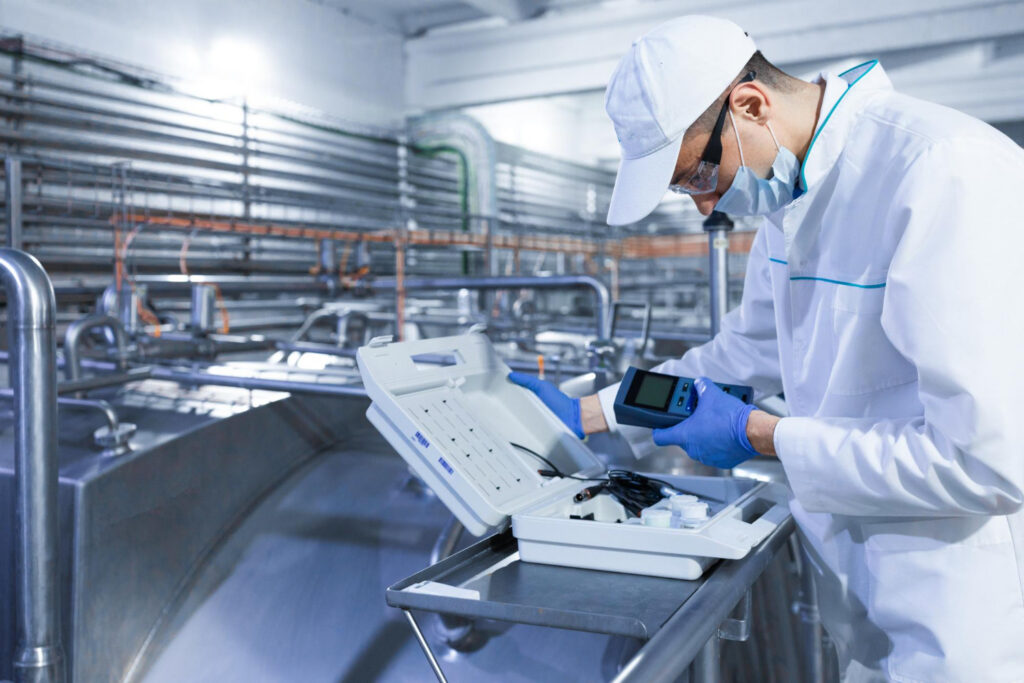
Environmental monitoring in hospitals
An EMS in a hospital: a standard taking hold in Belgium and France
In hospitals, environmental monitoring is no longer a luxury but a regulatory and operational necessity.
It protects the health of patients, medical staff, and visitors.
If we carefully monitor the rooms where medicines are manufactured, how could we not do the same in the rooms where people undergo surgery?
Environmental conditions directly influence:
- the quality of pharmaceutical preparations made on site,
- the spread of infections (including hospital-acquired infections),
- and the recovery and safety of the most vulnerable patients.
In short: some hospital areas are so critical that they require continuous, documented monitoring to maintain the highest safety standards.
Focus on Particle Counting
Counting particles is essential
In a hospital environment, airborne particles are true “taxis” for bacteria and allergens.
Particle counting makes it possible to control air quality, quickly identify contamination sources, and take action before a problem occurs.
With an EMS (Environmental Monitoring System), it is possible to integrate any type of particle counter to measure particle concentration in real time and to automatically trigger alerts and immediate corrective actions.
Belgium vs France: the gap is narrowing
Regulatory requirements for air quality vary from country to country.
In Belgium, continuous monitoring of operating rooms is regulated by the Federal Public Service (FPS) Health. The Royal Decree of December 15, 2020, for example, mandates real-time monitoring of critical parameters (pressure, temperature, humidity, particles) in ISO 5 rooms, with automatic recording and full traceability.
In France, regulations (notably NF S90-351:2013 and Ministry of Health circulars) also require strict air-quality control: pressure, air changes, microbiology.
However, continuous particle counting is not yet widespread. Most facilities perform regular, documented measurements, while permanent monitoring is mainly introduced in new operating theatres or pilot projects.
Where particle counting really makes a difference
In a hospital, several departments require precise control of air quality. According to local standards (NF S90-351, ISO 14644, GMP), the goal remains the same: protect the patient, staff, and product/procedure.
Continuous monitoring by hospital department
| Hospital department | Parameters continuously monitored | Purpose | Methods / Devices |
|---|---|---|---|
| Hospital pharmacy (sterile preparations) | Temperature, RH, differential pressure, particles, biocontamination | GMP compliance, product/patient safety | T°/RH sensors, pressure sensors, particle counters (28 L/min), monitored airlocks, EMS/BMS integration |
| Operating theatre / hybrid room | T°, RH, pressure, particles (ISO 5 at point of use), air changes | Prevent surgical infections, comply with ISO 14644 | Environmental sensors, particle counters, HVAC supervision, EMS alarms |
| Cardiology / interventional radiology, endoscopy | T°, pressure, particles at point of use, air changes | Sterile procedures in high-risk environments | Fixed sensors + mobile points, EMS trending, threshold alarms |
| ICU / critical care / burn unit | T°, RH, pressure, air changes, particles | Protect immunocompromised patients, control contamination | Networked sensors, data loggers, HVAC supervision linked to EMS |
| Neonatology (NICU) | T°, RH, pressure, particles; CO₂ (if incubators), noise (if monitored) | Fragility of premature newborns | T°/RH/CO₂ sensors, incubator monitoring, EMS alarms |
| Assisted reproduction / IVF (embryology/andrology) | Particles, T°, RH, CO₂, VOCs, pressure | Sensitivity of gametes/embryos to pollutants, success of cycles | Particle counters, CO₂/VOC probes, T°/RH, pressure; ISO 5 workstations; EMS + traceability |
| Radiopharmacy / ATMP (advanced therapies) | Particles, T°, RH, pressure, biocontamination | Product integrity, operator safety | Monitored isolators/LAF, integrated sensors, qualified EMS |
| Central sterilization (CSSD) | T°, RH in clean/dirty zones, differential pressure; cycle parameters | Effective sterilization, avoid recontamination | Zone sensors, autoclave recorders, EMS audit trail |
| Endoscope reprocessing (AER) | T°, pressure, air quality in clean/dirty zones | Control risk of recontamination | Sensors, pressure separation, deviation alarms |
| Laboratories (medical biology, cell culture) | T°, RH, pressure, air quality, incubators | Reliability of analyses, culture stability | Networked sensors, connected thermostats, EMS alarms |
| Blood bank | T° (2–6 °C), bag agitation, door alarms | Preserve integrity of blood components | Certified refrigerators, recorders, dual alarm 24/7 |
| Cryobanks (liquid nitrogen / –80 °C) | T°, LN₂ level, local pressure, alarms | Long-term preservation of samples | T° probes, level sensors, alarm redundancy, EMS |
| Isolation rooms (airborne infection risk) | Negative/positive pressure, air changes, T°/RH | Containment/protection as required | Pressure sensors, airflow sensors, HVAC supervision + EMS |
| Cold rooms / refrigerators | T° (2–8 °C / –20 °C / –80 °C), door openings | Vaccines, blood products, temperature-sensitive medicines | Data loggers, T° sensors, technical alarms, BMS/EMS |
| Sterile store / device storage | T°, RH, pressure | Maintain sterility until use | T°/RH/pressure sensors, threshold alarms, trending |
Best practices: define zone-specific thresholds, enable staged alarms (pre-alarm/alarm), log every deviation (audit trail), and use trending for proactive CAPA planning.
Sensor calibration & flow control: start with “why”
Why it matters
In a hospital, air is constantly in motion: staff movements, door openings, ventilation cycles, medical procedures…
Particle levels can change very quickly.
If measurements are inaccurate (poor calibration) or not representative (low flow), there is a risk of underestimating critical events.
Limitations of common practices
- Flow rates that are too low lead to reduced sensitivity, non-representative sampling, undetected transient peaks, and sometimes underestimated results.
- Insufficient calibration leads to systematic errors, slow drift, distorted data, and ultimately weak decision-making.
- Unstable flow control degrades sensor performance, scatters measurements, and complicates interpretation and alerting.
What proper calibration ensures
Regular, traceable calibration:
- ensures accuracy (no bias) and repeatability of measurements,
- secures alarm thresholds and trends,
- makes data auditable and actionable for qualifications, deviations, and CAPA.
Particle counters: why aim for a high flow rate (28 L/min, 1 ft³/min)
In critical areas, especially ISO 5 (e.g. operating theatres), a 28 L/min flow rate offers major advantages:
- More representative and consistent measurement
Sampling a larger air volume reduces the effect of momentary fluctuations and provides a truer picture of real trends. - More reliable detection of transient events
By drawing in more air per unit of time, the probability of capturing brief but significant spikes is increased, giving a more complete assessment of air quality and potential health risks. - More comprehensive monitoring of critical areas
High flow limits “blind spots” around the point of use (surgical field, critical workstation) and strengthens continuous monitoring coverage. - Alignment with best practices
A 28 L/min flow rate supports qualification and continuous monitoring of ISO 5 areas in line with leading environmental monitoring practices and hospital hygiene requirements.
High flow allows for more relevant alarm thresholds, more reliable alerts, and robust trending—ensuring quick, well-founded, patient- and staff-oriented decisions.
Focus 2025: PIC/S and hospital pharmacies
On January 1, 2026, the new requirements of the Pharmaceutical Inspection Co-operation Scheme (PIC/S) will become mandatory for European hospital pharmacies.
The aim is to ensure that every in-house manufactured medicine meets the highest Good Manufacturing Practice (GMP) standards.
PIC/S standards demand thorough monitoring of hospital infrastructure and the production environment. This means comprehensive cleanroom and product testing, stricter gowning procedures, and additional staff.
Consequences:
- Stronger environmental controls.
- More documented and traceable processes.
- Planned human and financial investments.
But the benefit is clear: greater quality and patient safety.
EMS in hospitals: an investment that pays off
Choosing a monitoring solution like Mirrhia means:
- Instantly identifying risk areas,
- Taking action before incidents occur,
- Guaranteeing ideal conditions for patients and staff.
In one word: protect and optimize.
From operating theatres to hospital pharmacies, Mirrhia provides a monitoring and traceability platform designed for critical environments and fully aligned with PIC/S requirements.
A final word
Investing in an EMS is not optional:
it means ensuring quality of care, securing operations, and anticipating regulations.
Mirrhia helps you turn this requirement into a strategic advantage—today and in the years to come.
Discover Mirrhia Institute, the tailor-made EMS solution for hospitals.
Would you like to discuss with us?